
Ramadan and Islamic calendar
Eid al-Adha and Qurbani in Kenya
Eid al-Adha is the Festival of Sacrifice. In 2027 it is expected on about Sunday 16 May, and Muslims who can afford it offer Qurbani and share the meat.
Eid al-Adha is the Festival of Sacrifice on 10 Dhul Hijjah, expected on about Sunday 16 May 2027. It remembers Prophet Ibrahim’s (peace be upon him) readiness to obey Allah. Muslims who can afford it offer Qurbani (a sheep, goat, cow or camel) after the Eid prayer and share the meat with family, neighbours and people in need.
What is Eid al-Adha?
Eid al-Adha means the Festival of Sacrifice. It is one of the two Eids in Islam. It falls on the 10th day of Dhul Hijjah, the last month of the Islamic calendar, and it comes at the end of the Hajj pilgrimage season.
Muslims all over the world, whether on Hajj or at home, celebrate it. It is a day of prayer, thanks, family and sharing food with others. Read more about the pilgrimage in Hajj and Umrah.
When is Eid al-Adha 2027 in Kenya?
Eid al-Adha 2027 is expected on about Sunday 16 May 2027. The exact date depends on the moon sighting for Dhul Hijjah, so it can move by one day.
| Event | Expected date | Notes |
|---|---|---|
| First 10 days of Dhul Hijjah begin | About 7 May 2027 | Depends on the moon |
| Day of Arafah (9 Dhul Hijjah) | About Saturday, 15 May 2027 | Fasting is recommended for those not on Hajj |
| Eid al-Adha (10 Dhul Hijjah) | About Sunday, 16 May 2027 | Eid prayer, then Qurbani can begin |
| Last day for Qurbani (13 Dhul Hijjah) | About 19 May 2027 | Qurbani time is 10 to 13 Dhul Hijjah |
See all the dates in Islamic calendar 2027.
What is the story behind Eid al-Adha?
Eid al-Adha remembers Prophet Ibrahim (peace be upon him). Allah tested him by asking him to sacrifice his son Ismail. Both of them were ready to obey Allah. Before the sacrifice was done, Allah replaced it with a ram. The story is told in the Qur’an in chapter 37 (Surah as-Saffat).
The lesson is trust in Allah, obedience and sacrifice. Today Muslims remember this by offering an animal and sharing the meat with others.
What is Qurbani?
Qurbani, also called Udhiyah, is the sacrifice of an animal for the sake of Allah on the days of Eid al-Adha. It is done by Muslims who can afford it. Scholars differ on whether it is obligatory or strongly recommended, so ask your local scholar which applies to you.
The meat is for eating and for giving. The sacrifice must be done with the intention of worship, and the meat should not be sold.
Which animals can be used for Qurbani?
The animals commonly accepted are sheep, goats, cattle and camels. The animal must be healthy and free from clear faults such as blindness, severe illness or lameness. Animals must also reach a minimum age. The minimum ages differ between scholars and schools of thought, so ask your scholar.
| Animal | Who it covers |
|---|---|
| Sheep | One person (one animal) |
| Goat | One person (one animal) |
| Cattle (cow, bull, ox) | One person, or up to seven people share one animal |
| Camel | One person, or up to seven people share one animal (some scholars allow up to ten) |
A large animal such as a cow or camel can be shared by up to seven people, as is widely taught. For a sheep or goat, one animal is for one person.
When can I do Qurbani?
Qurbani is done after the Eid al-Adha prayer on 10 Dhul Hijjah. The time continues until the end of 13 Dhul Hijjah, so it can be done on four days. An animal slaughtered before the Eid prayer does not count as Qurbani.
Scholars differ on whether the last day is the 12th or the 13th, and on whether night-time slaughter is allowed. The 10th to 13th is the most widely used time, and the first day is best. A person who intends to sacrifice is advised not to cut hair or nails from the start of Dhul Hijjah until the sacrifice. Ask your scholar for details.
How should the Qurbani meat be shared?
It is recommended to divide the meat into three parts. You may give more to people in need, because it is a day to feed the poor.
| Share of the meat | Given to |
|---|---|
| One third | Your family and household |
| One third | Relatives, friends and neighbours |
| One third | People in need |
The butcher should be paid separately, not with the meat. In Kenya, many people give the meat to neighbours, relatives and families who rarely eat meat. Read Charity in Islam.
How is Eid al-Adha observed in Kenya?
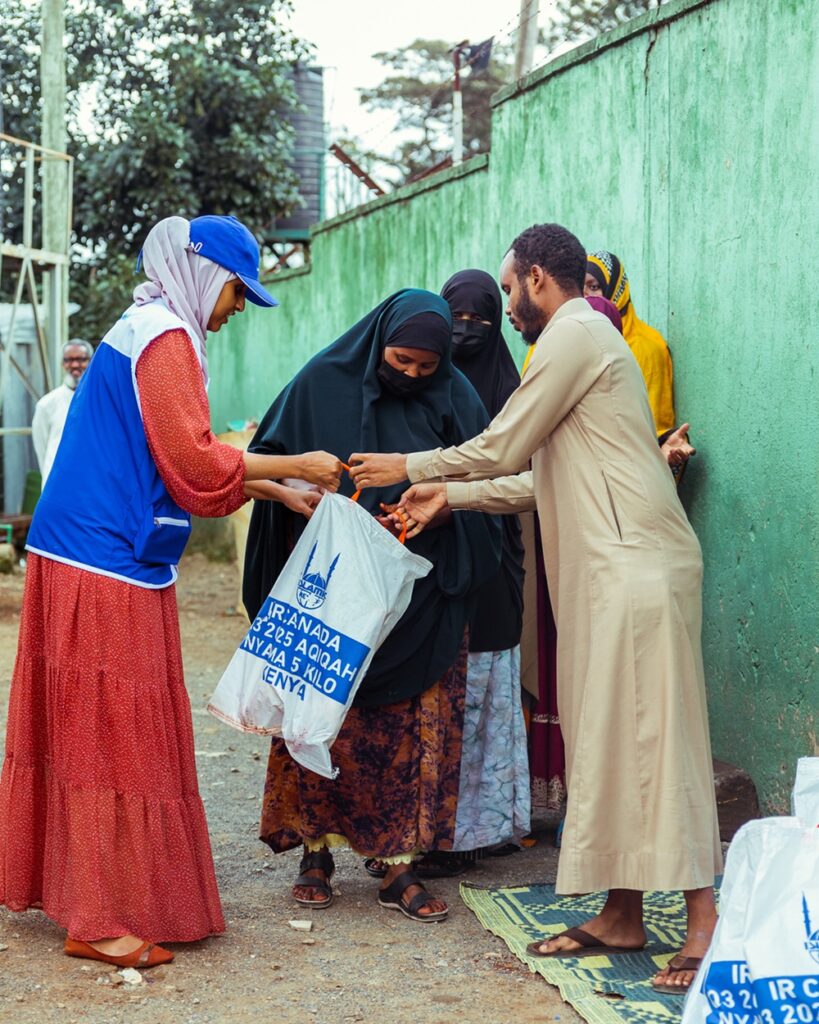
Kenya has a large livestock-keeping community, especially in pastoralist counties in the north and north-east such as Garissa, Wajir and Mandera. Many families there keep goats, sheep, cattle and camels, so Qurbani is part of their life. In towns like Nairobi and Mombasa, people often buy animals from local markets or butchers and attend the Eid prayer in large grounds and mosques.
If you cannot do the sacrifice yourself, you may ask a trusted organisation to do it for you. Check our donate page for Qurbani options: donate.islamic-relief.or.ke. Islamic Relief Kenya is registered with the Kenya NGO Board (Reg. No. 218/051/204/0374/3386).
Support families in Kenya
Check our donate page for Qurbani options. Pay by M-Pesa or card.
Visit our donate pageFrequently asked questions
When is Eid al-Adha 2027?
Eid al-Adha 2027 is expected on about Sunday 16 May 2027, which is 10 Dhul Hijjah. The Day of Arafah is about 15 May. The exact date depends on the moon sighting, so it may move by one day.
What is Eid al-Adha?
Eid al-Adha is the Festival of Sacrifice, celebrated on 10 Dhul Hijjah. It remembers the readiness of Prophet Ibrahim (peace be upon him) to obey Allah. Muslims pray the Eid prayer, offer Qurbani and share the meat.
What is Qurbani?
Qurbani, or Udhiyah, is the sacrifice of an animal for Allah on the days of Eid al-Adha, by Muslims who can afford it. The meat is shared with family, neighbours and people in need.
Which animals are allowed for Qurbani?
Sheep, goats, cattle and camels are accepted. They must be healthy, free from clear faults and of the minimum age. Minimum ages differ between scholars, so ask your scholar.
Can I share a cow for Qurbani?
Yes. A cow or camel can be shared by up to seven people. A sheep or goat counts for one person. Some scholars allow up to ten shares in a camel. Ask your scholar if unsure.
When can I perform Qurbani?
Qurbani is done after the Eid al-Adha prayer on 10 Dhul Hijjah and up to 13 Dhul Hijjah. It does not count if done before the Eid prayer. The first day is best.
How should Qurbani meat be distributed?
It is recommended to split it in three: one third for your household, one third for relatives, friends and neighbours, and one third for people in need. You may give more to those in need.
Is Qurbani compulsory?
Scholars differ. Some say it is obligatory for those who can afford it, and others say it is strongly recommended. Ask your local scholar which applies to you.
Can I fast on the Day of Arafah?
Fasting on the Day of Arafah, 9 Dhul Hijjah, is recommended for Muslims who are not on Hajj. In 2027 it is expected on about 15 May.
Rulings on this page are general guidance, not a fatwa. Ask your local scholar about your own situation. Dates are expected dates. Last reviewed 2 October 2026.
More from Islamic Relief Kenya
Turn knowledge into giving
Give your Zakat or Sadaqah in Kenya shillings by M-Pesa or card. M-Pesa PayBill 949210.